> ## Documentation Index
> Fetch the complete documentation index at: https://wb-21fd5541-style-guide-models-runs-20260604-113608.mintlify.site/llms.txt
> Use this file to discover all available pages before exploring further.
> Organize your runs into groups and other properties.
# Organize runs
Organize your runs into *groups* to make related experiments easier to find, compare, and analyze in the W\&B App. A group is a collection of runs that share a common purpose, such as training runs for a specific model or evaluation runs for a specific dataset.
You can also organize runs by other properties such as *job type*. [Job types](/models/runs/grouping#organize-runs-by-job-type) indicate the function of a run, such as `preprocessing`, `training`, or `evaluation`. When you have many runs in a project, use these organizational properties to view or filter runs by their function or experiment.
## Organize runs into groups
You can add runs to a group programmatically using the W\&B Python SDK or interactively in the W\&B App.
W\&B stores group names as a run [`wandb.Run.group`](/models/ref/python/experiments/run#property-run-group) property.
Programmatically add one or more runs to a group with the W\&B Python SDK. When you initialize a run with `wandb.init(group="")`, pass the name of your group as an argument to the `group` parameter. You can then use group names to organize and filter runs in the W\&B App.
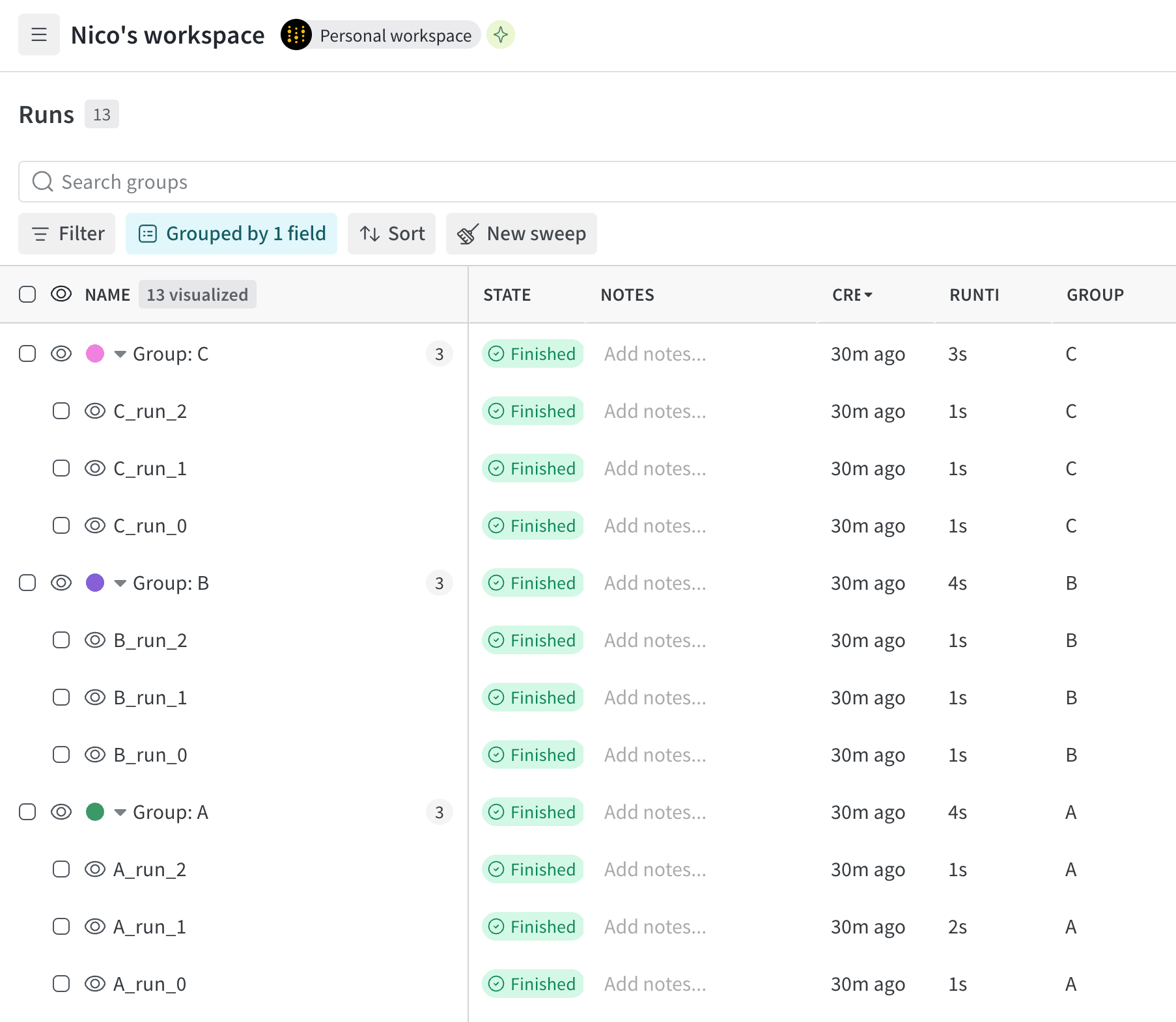
The following example creates three groups named `A`, `B`, and `C`. Each group contains three runs.
```python theme={null}
import wandb
entity = "[ENTITY]"
project = "[PROJECT]"
for group in ["A", "B", "C"]:
for i in range(3):
with wandb.init(entity=entity, project=project, group=group, name=f"{group}_run_{i}") as run:
# Simulate some training
for step in range(100):
run.log({
"acc": 0.5 + (step / 100) * 0.3 + (i * 0.05),
"loss": 1.0 - (step / 100) * 0.5
})
```
In the project's workspace, you can view runs organized by group. The following image illustrates organizing the runs table by group name. Three groups named `A`, `B`, and `C` appear in the runs table, each containing three runs.
 To add runs to a group from the W\&B App:
1. Navigate to your W\&B project.
2. Select the **Runs** tab from the project sidebar.
3. Above the list of runs, click the **Group** button.
4. Click the checkbox next to one or more runs you want to group.
5. Select **Move to group**.
6. In the drawer, select an existing group or create a new group.
### View groups
After you assign runs to groups, you can view them organized by group in the W\&B App. Use this view to compare related runs side by side.
1. In your project sidebar, select the **Runs** tab.
2. Above the list of runs, click the **Group** button.
3. From the dropdown, select a **Group**.
### Move runs between groups
Reorganize your runs by moving them from one group to another. This is useful when you want to regroup runs after an experiment, or when you assigned runs to the wrong group.
1. Navigate to your W\&B project.
2. Select the **Runs** tab from the project sidebar.
3. Select one or more runs by clicking their checkboxes.
4. Above the table, click **Move to group**.
5. Within the drawer, select the target group or create a new group.
6. Click **Move**.
### Remove runs from a group
Remove runs from a group when they no longer belong to that experiment or workflow.
1. Navigate to your W\&B project.
2. Select the **Runs** tab from the project sidebar.
3. Above the list of runs, click the **Group** button.
4. From the dropdown, select the **X** next to the name of the group you want to remove.
### Delete a group
Groups exist only as long as they contain runs. To delete a group, remove all runs from it. This automatically deletes the group.
## Organize runs by job type
Besides groups, you can organize runs by their *job type*. A job type indicates the function of a run, such as `preprocessing`, `training`, or `evaluation`. Assign a job type to distinguish runs that play different roles in the same workflow.
View a run's job type by accessing the run's [`wandb.Run.job_type`](/models/ref/python/experiments/run#property-run-job-type) property.
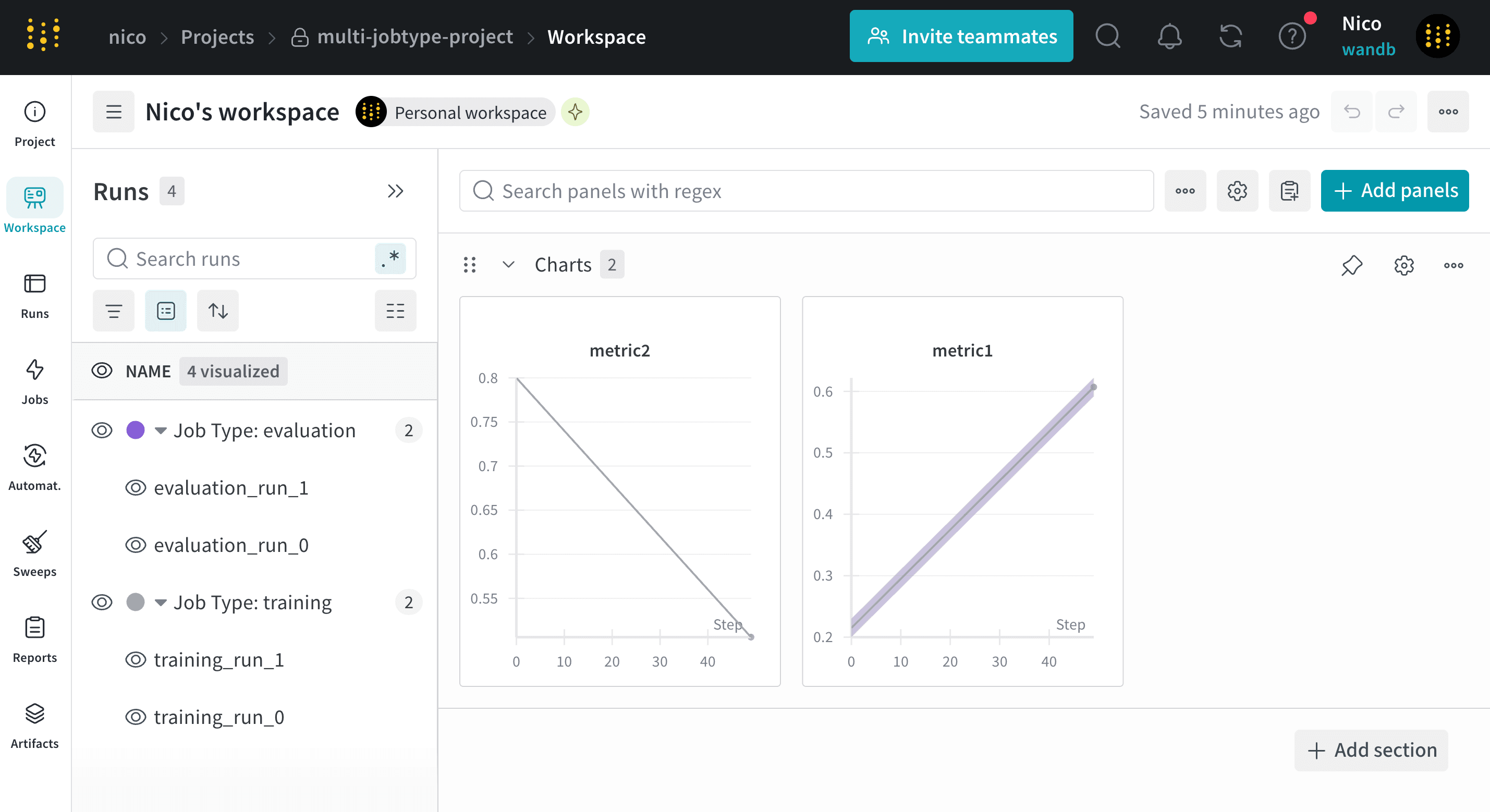
Add a job type to a run by passing the `job_type` parameter to `wandb.init(job_type="")`. For example, the following code snippet creates runs with job types of either `training` or `evaluation`:
```python theme={null}
import wandb
entity = "[ENTITY]"
project = "[PROJECT]"
for job_type in ["training", "evaluation"]:
for i in range(2):
with wandb.init(entity=entity, project=project, job_type=job_type, name=f"{job_type}_run_{i}") as run:
# Simulate some process
for step in range(50):
run.log({
"metric1": 0.2 + (step / 50) * 0.4 + (i * 0.03),
"metric2": 0.8 - (step / 50) * 0.3
})
```
The following image shows runs organized by job type:
To add runs to a group from the W\&B App:
1. Navigate to your W\&B project.
2. Select the **Runs** tab from the project sidebar.
3. Above the list of runs, click the **Group** button.
4. Click the checkbox next to one or more runs you want to group.
5. Select **Move to group**.
6. In the drawer, select an existing group or create a new group.
### View groups
After you assign runs to groups, you can view them organized by group in the W\&B App. Use this view to compare related runs side by side.
1. In your project sidebar, select the **Runs** tab.
2. Above the list of runs, click the **Group** button.
3. From the dropdown, select a **Group**.
### Move runs between groups
Reorganize your runs by moving them from one group to another. This is useful when you want to regroup runs after an experiment, or when you assigned runs to the wrong group.
1. Navigate to your W\&B project.
2. Select the **Runs** tab from the project sidebar.
3. Select one or more runs by clicking their checkboxes.
4. Above the table, click **Move to group**.
5. Within the drawer, select the target group or create a new group.
6. Click **Move**.
### Remove runs from a group
Remove runs from a group when they no longer belong to that experiment or workflow.
1. Navigate to your W\&B project.
2. Select the **Runs** tab from the project sidebar.
3. Above the list of runs, click the **Group** button.
4. From the dropdown, select the **X** next to the name of the group you want to remove.
### Delete a group
Groups exist only as long as they contain runs. To delete a group, remove all runs from it. This automatically deletes the group.
## Organize runs by job type
Besides groups, you can organize runs by their *job type*. A job type indicates the function of a run, such as `preprocessing`, `training`, or `evaluation`. Assign a job type to distinguish runs that play different roles in the same workflow.
View a run's job type by accessing the run's [`wandb.Run.job_type`](/models/ref/python/experiments/run#property-run-job-type) property.
Add a job type to a run by passing the `job_type` parameter to `wandb.init(job_type="")`. For example, the following code snippet creates runs with job types of either `training` or `evaluation`:
```python theme={null}
import wandb
entity = "[ENTITY]"
project = "[PROJECT]"
for job_type in ["training", "evaluation"]:
for i in range(2):
with wandb.init(entity=entity, project=project, job_type=job_type, name=f"{job_type}_run_{i}") as run:
# Simulate some process
for step in range(50):
run.log({
"metric1": 0.2 + (step / 50) * 0.4 + (i * 0.03),
"metric2": 0.8 - (step / 50) * 0.3
})
```
The following image shows runs organized by job type:
 ### View runs organized by job type
After you assign job types to runs, you can view them grouped by job type in the W\&B App. This view helps you compare runs that perform the same function across your project.
1. In your project sidebar, select the **Runs** tab.
2. Above the list of runs, click the **Group** button.
3. From the dropdown, select **Job Type**.
### View runs organized by job type
After you assign job types to runs, you can view them grouped by job type in the W\&B App. This view helps you compare runs that perform the same function across your project.
1. In your project sidebar, select the **Runs** tab.
2. Above the list of runs, click the **Group** button.
3. From the dropdown, select **Job Type**.